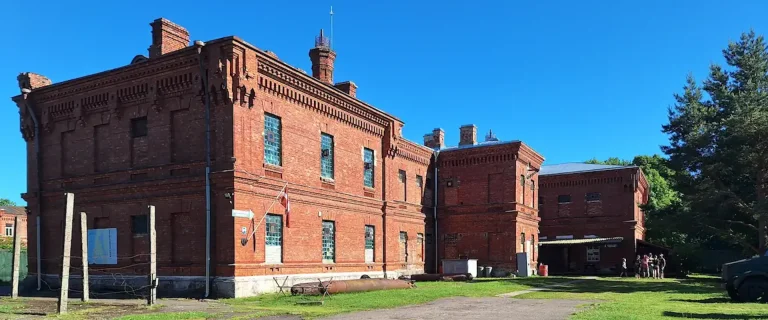
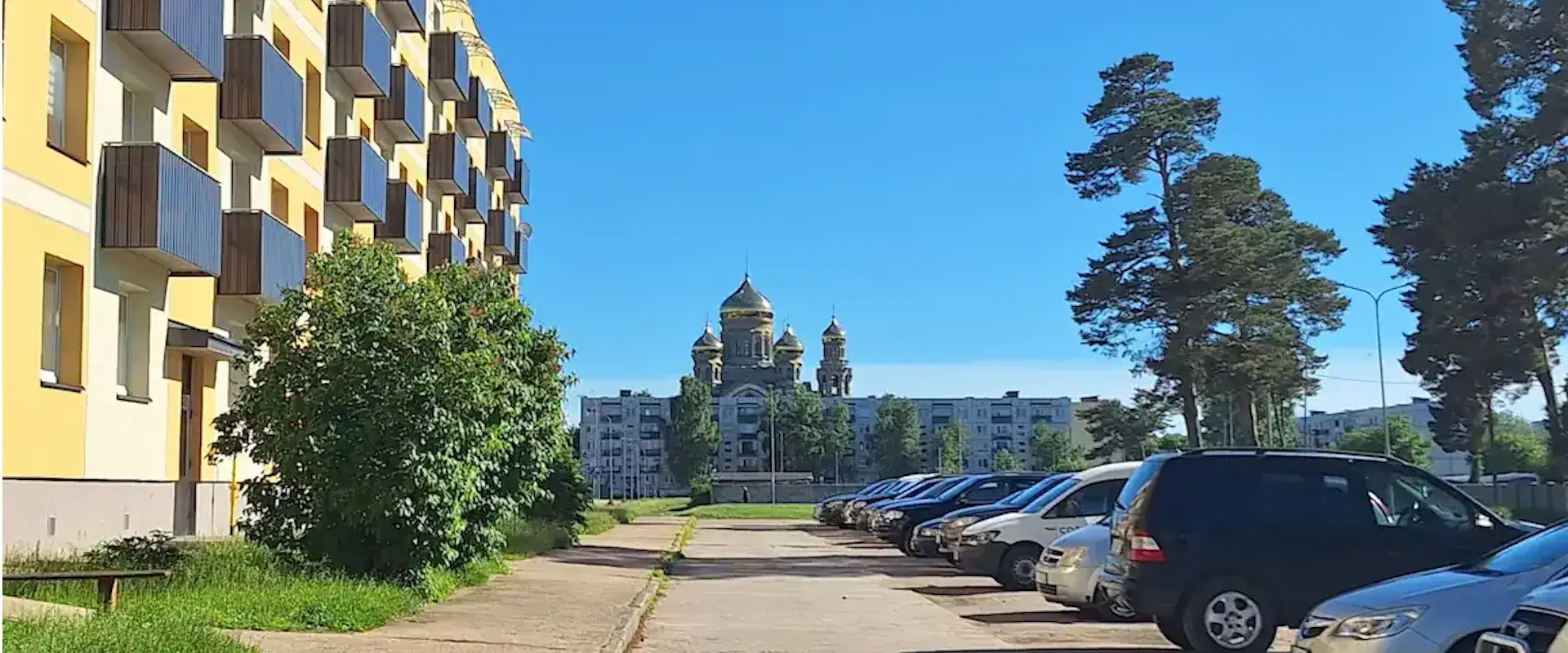

Most visitors to Liepāja know Karosta exists. Fewer have a clear sense of what they’ll actually find there. Read any travel blog from over ten years ago, and you’d wonder if the area is actually safe to visit.
Quick facts
- Location: 4km north of Liepāja city centre
- Entry: Free, except Karosta Prison (paid)
- Getting there: Bus 1, 3, 12A or 12B ~20 min, €1.00
- Time needed: Half day minimum, full day for the Forts
- Best for: Cold War history, dark tourism, photography, self-guided exploration
- Not ideal if: Travelling with children under 12, or you only have an hour
- Worth knowing: Karosta is a real, safe, inhabited neighbourhood — not the abandoned ghost town older blog posts describe
Karosta is a real neighbourhood — widely inhabited, perfectly safe — where people have chosen to live among Tsarist-era officers’ mansions, Soviet apartment blocks, a functioning Orthodox cathedral, and the ruins of a 19th-century military fortress on the Baltic coast. That combination doesn’t exist anywhere else — in the world.
The distinctive atmosphere tourists notice isn’t danger. It’s the absence of tourist infrastructure — no café on every corner, no heritage signage at each building, no curated experience between the prison and the forts. Even the attempts to have a cafe at the breakwater (mols) is a bit of a let-down.
What’s there instead is an honest, non-curated neighbourhood with a history you can read in the buildings around you.
This guide covers what Karosta is, what’s there, and how to plan a visit without missing the parts that really matter.
→ This guide has information on more things to do in Liepāja after you’ve spent time in Karosta.
What is Karosta?
Karosta is a former Russian Imperial and Soviet naval base occupying the northern third of Liepāja, Latvia. Built from 1890 on the orders of Tsar Alexander III, it was designed as a fully self-contained military city — its own power plant, water supply, hospital, schools, and cathedral. At its peak during Soviet occupation, it housed over 20,000 people. Soviet forces withdrew in 1994.
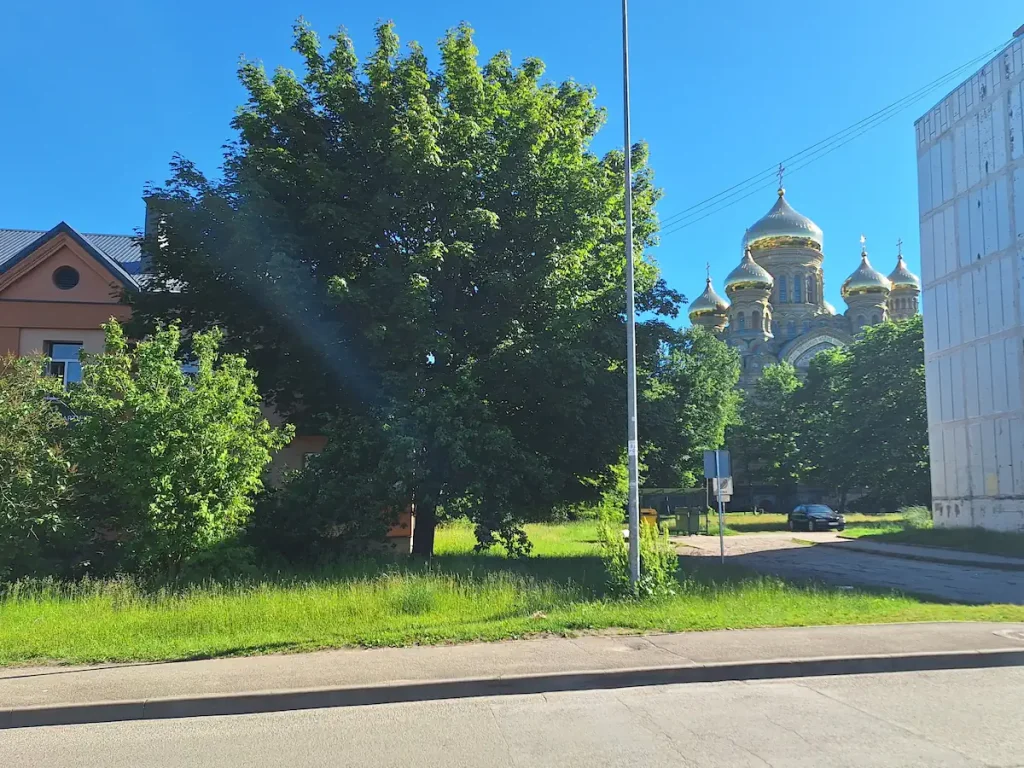
The name comes from kara osta — Latvian for “war port.” During the Russian Imperial period, the base was officially called Port Imperatora Aleksandra III. The name Karosta emerged after Latvian independence in 1918, was suppressed under Soviet rule, and returned after 1991.
Today it’s a residential neighbourhood — properly inhabited, safe, and increasingly sought after.
It’s a place where the architecture tells the full story of 130 years of military history. Tsarist brick mansions, Soviet-era apartment blocks, a restored Orthodox cathedral with golden domes, and coastal fortress ruins, all in the same postcode.
Karosta isn’t a heritage attraction. It’s somewhere people live and where visitors can walk around freely.
The city that didn’t officially exist
During the Soviet occupation, Karosta was designated a closed city — закрытый город (zakryty gorod).
Like all Soviet closed cities, it had its own separate postal district. A letter sent from Karosta to Liepāja required an inter-city stamp, not a local one — as if the two places were in different towns entirely.
Liepāja residents could not cross the Kalpaka bridge without a permit. Visiting a relative in Karosta required formal official permission. The canal was the border, and the border was real. Sand on the beach was raked every evening and checked every morning for footprints — people trying to desert the city over the Baltic Sea.
Most Soviet closed cities were remote, hidden by geography. Karosta was hidden by administration — pressed directly against a civilian city, invisible by bureaucratic design. That’s what makes it unusual.
Built for the Tsar (1890–1918)
Construction began in 1890 on a bare stretch of Baltic coast. The brief was ambitious: a fully operational naval fortress with a submarine base, dry docks, a breakwater, and a completely self-sufficient settlement for the men who would staff it.
The Northern Forts were built as the outer defensive ring. In 1908 — just eight years after completion — the entire fortress was declared a strategic mistake and partially demolished. The forts were blown up before they fired a shot in anger.
What survived: the cathedral (built 1900–1903, consecrated by Tsar Nicholas II and his family in August 1903), the cavalry manège, the water tower, the Kalpaka bridge (opened 1906), and the grid of officers’ mansions and administrative buildings that still define the southern half of Karosta today.
The Soviet closed city (1945–1994)
Under Soviet occupation Karosta became one of the Baltic Fleet’s key bases. A submarine bunker was constructed inside the canal basin. The population grew to over 20,000 as rows of five-storey prefab apartment blocks went up across the northern sections.
The cathedral’s domes were removed. The building was repurposed as a Navy social club. The military prison — which had operated continuously through the Tsarist era, German occupation, and the Soviet period — kept operating until 1997.
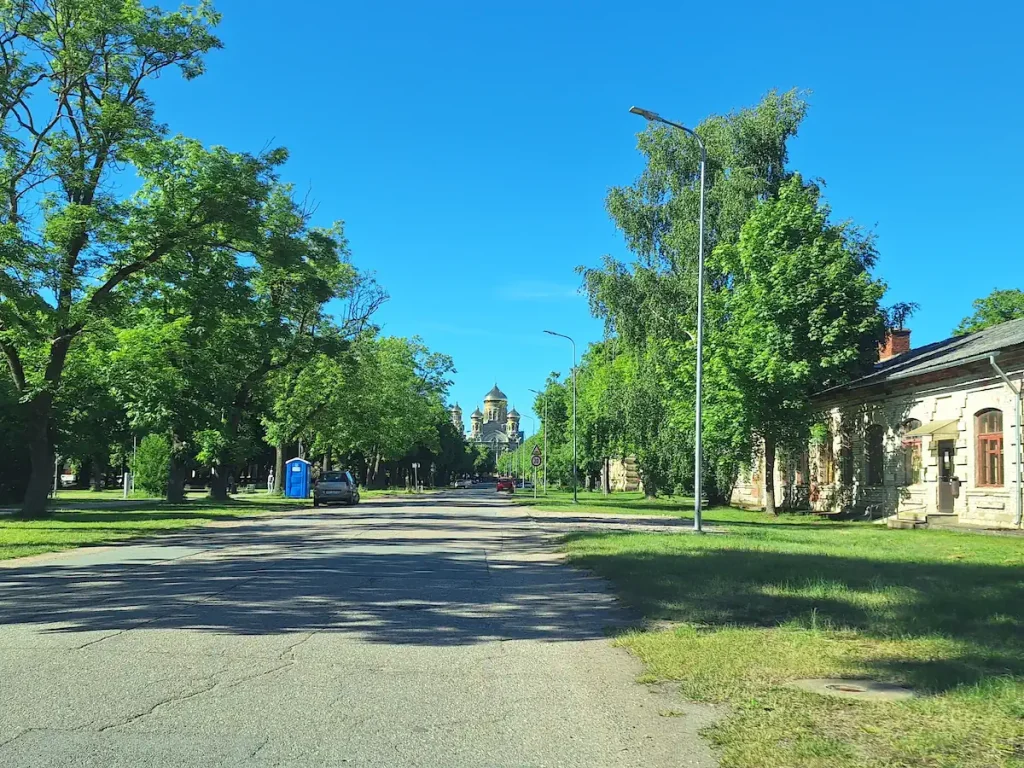
The city behind the wire had everything it needed and nothing that connected it to Liepāja next door. Civilians on the Liepāja side could see the cathedral spires from certain streets. They couldn’t cross the bridge without a permit.
After 1994
Soviet forces withdrew from Latvia in 1994. The years that followed were difficult — population fell, some blocks emptied, and the area had a genuinely rough edge through the late 1990s and into the 2000s. The transition took time.
That period is largely behind Karosta now. The cathedral was restored, its golden domes back in place. Karosta Prison reopened as a museum in 2002. The K@2 Artists Centre established itself in 2000, drawing artists from across Europe. The neighbourhood stabilised, and then recovered.
Now, people choose to move to Karosta for the space, the character of the buildings, and the price relative to central Liepāja.
What you’ll find isn’t a post-Soviet ruin or a ghost town — like many travel blogs would make you believe. It’s a neighbourhood that went through something difficult and came out the other side with a distinct identity — one that no amount of heritage management could manufacture.
Most of what’s written about Karosta online dates from around 2014. The ghost-town framing, the safety warnings, the photographs of empty blocks — that was an accurate picture at the time. Travel content ages badly when nobody updates it, and Karosta has moved on considerably faster than the articles about it. This guide was written in 2026 by someone who lives here.
As Liepāja prepares for its role as European Capital of Culture 2027, Karosta’s layered history is increasingly central to how the city presents itself — not as a legacy to be hidden but as something genuinely worth understanding.
What to see in Karosta
Karosta’s main attractions — Karosta Prison, St Nicholas Naval Cathedral, and the Northern Forts — are all free or low-cost to access. Access to the prison building requires an entry fee and advance booking. The rest of the area can be explored independently on foot or by bicycle, with no tickets, no guides, and no set route required.
Karosta Prison
The prison in Karosta is Europe’s only military prison that’s open to visitors. Built around 1900, it served as a place of punishment and detention under three successive regimes — Russian Imperial, Nazi German, Soviet — each one keeping the same building for the same purpose. The last inmates left in 1997.
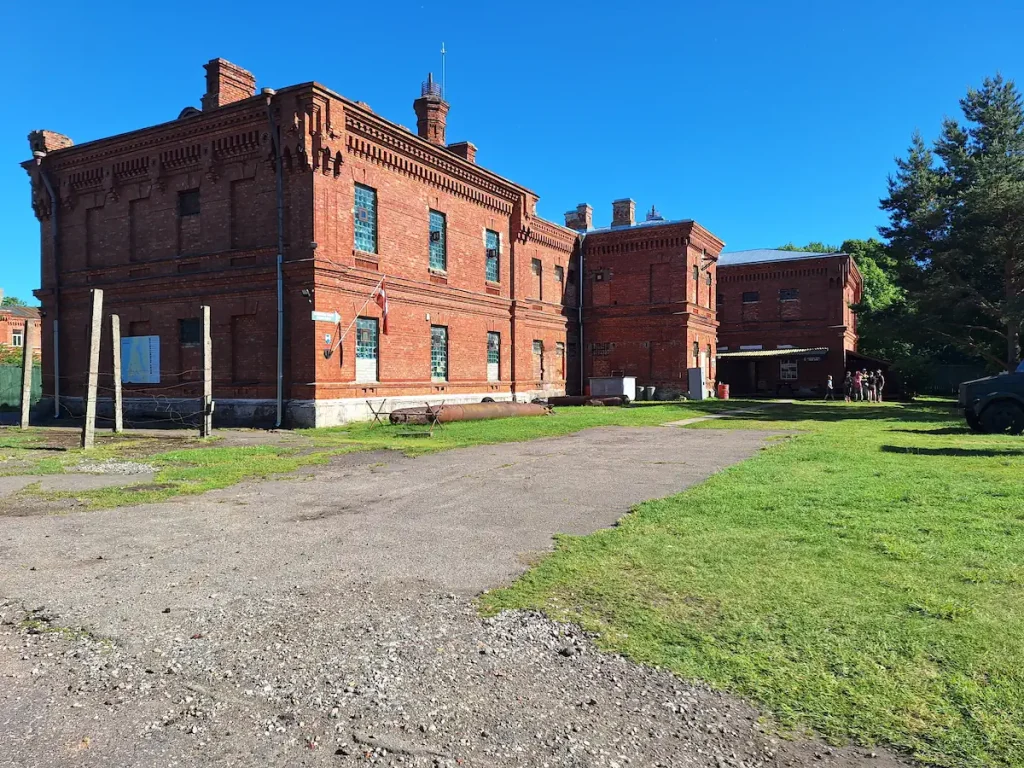
The prison runs several visitor experiences:
- Standard guided tour (~45 minutes): a walk through the cells, corridors, and solitary confinement block. The guide is in character throughout. You’ll hear about the history and the conditions. No waiver required. Suitable for most visitors.
- Behind the Bars (interactive): visitors are processed as military prisoners — marched, ordered, locked in cells. A signed waiver is required. Not suitable for young children or anyone averse to confrontational roleplay.
- Overnight stay: a night in a prison cell. Basic option includes a bunk and prison-issue meal; the “Extreme Night” involves full prisoner treatment from arrival. Both run from May to September.
Ghost Hunters International called Karosta Prison the most haunted building in the world. A Soviet-era café operates on site, and there’s a gift shop. But, definately, one of the most unique and unforgettable places to stay in Liepāja.
St Nicholas Naval Cathedral
Built 1900–1903 to a design based on 17th-century Russian Orthodox church architecture. Five domes — one central, four side. Consecrated 22 August 1903; Tsar Nicholas II and his family attended the ceremony.
During the Soviet occupation, the domes were removed, and the building was converted into a Navy social club. It was returned to the Orthodox Church in September 1991, ahead of formal Soviet military withdrawal. The restored bells were consecrated in September 2016.
The golden domes are the most immediately striking sight in Karosta — particularly against the grey Soviet-era apartment blocks that surround them on three sides. The interior is open to visitors. Women need to cover their heads. Photography is not permitted inside.
The two Karosta beaches
Karosta actually has two beaches, and they’re different enough that mixing them up will give you the wrong day.
Between the breakwater and the Northern Forts is open Baltic coastline — gritty sand mixed with stones, no shelter from the wind, and the collapsing fortifications as a backdrop. This is the stretch most people mean when they say Karostas pludmale. No facilities, no lifeguards. Worth the walk for the setting alone, but the underfoot grit is real — swim shoes help if you’re getting in.
Between the two breakwaters, close to the canal mouth, is a smaller and calmer beach. The breakwaters cut the open-sea swell, so the water here is shallower and noticeably gentler, and the sand is finer. It’s the more comfortable of the two to actually swim from, and the one locals with children tend to use.
Neither beach has facilities. Bring what you need with you. However, in the summer, there’s a cafe at the breakwater serving food and drink.
The Northern Forts
Artillery batteries constructed from 1890 as part of the outer ring of the Liepāja Fortress, declared strategically redundant in 1908, and partially blown up. What remains is a line of massive concrete structures slowly collapsing into the Baltic Sea — some already submerged, some still partially standing, all in the process of going.
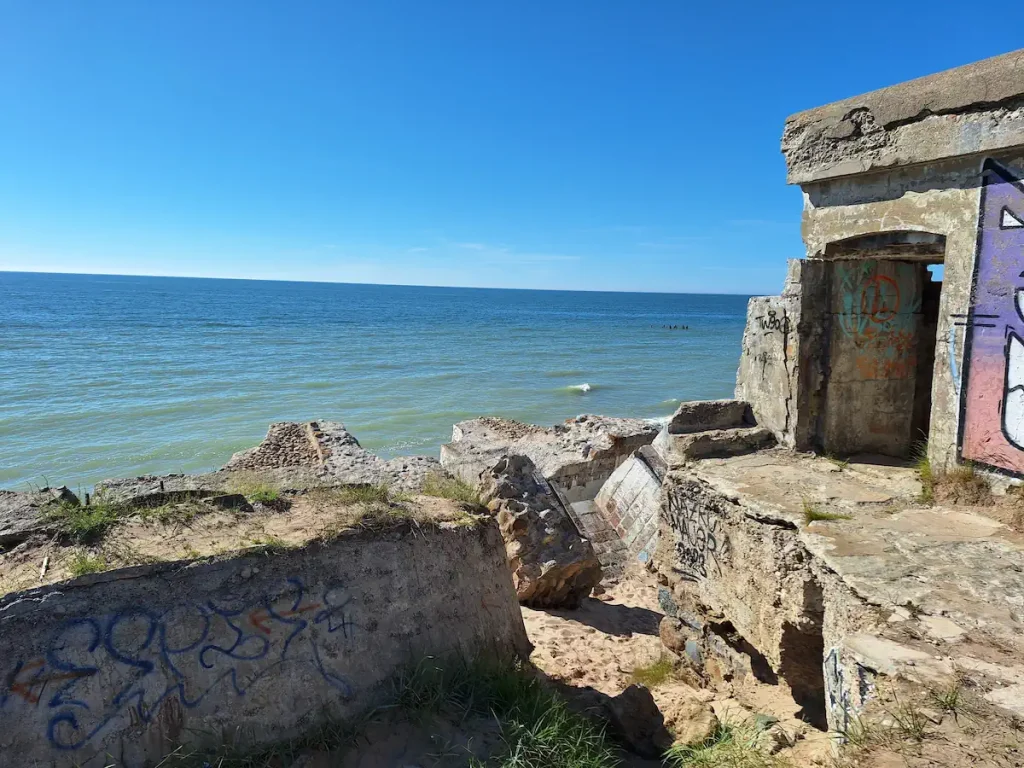
Entry is free. There’s a large car park at the site. The forts are open and unsupervised year-round.
Safety note: The coastal cliff above the forts is actively eroding. Do not walk under the ruins or approach the cliff edge from above. Coastal landslides are a documented and ongoing risk — the warning signs exist because the concrete comes down. Approach from the beach level and stay clear of the cliff sections.
The forts are best in low light — early morning, late afternoon, storm weather. In summer the beach below them is wide, sandy, and often quiet.
Kalpaka Swing Bridge
The gateway into Karosta from Liepāja is a 133-meter steel cantilever bridge that splits into two halves, each rotating 90 degrees to allow vessel traffic through the Karosta Canal. Opened in 1906. Still fully operational.
The bridge opens five times daily for ships (suspended when wind speed exceeds 10 m/s). Worth timing your arrival to watch it rotate — the mechanics are visible and satisfying. Although there’s a published schedule, the brige only opens and closed based on ships entering or exiting the port.
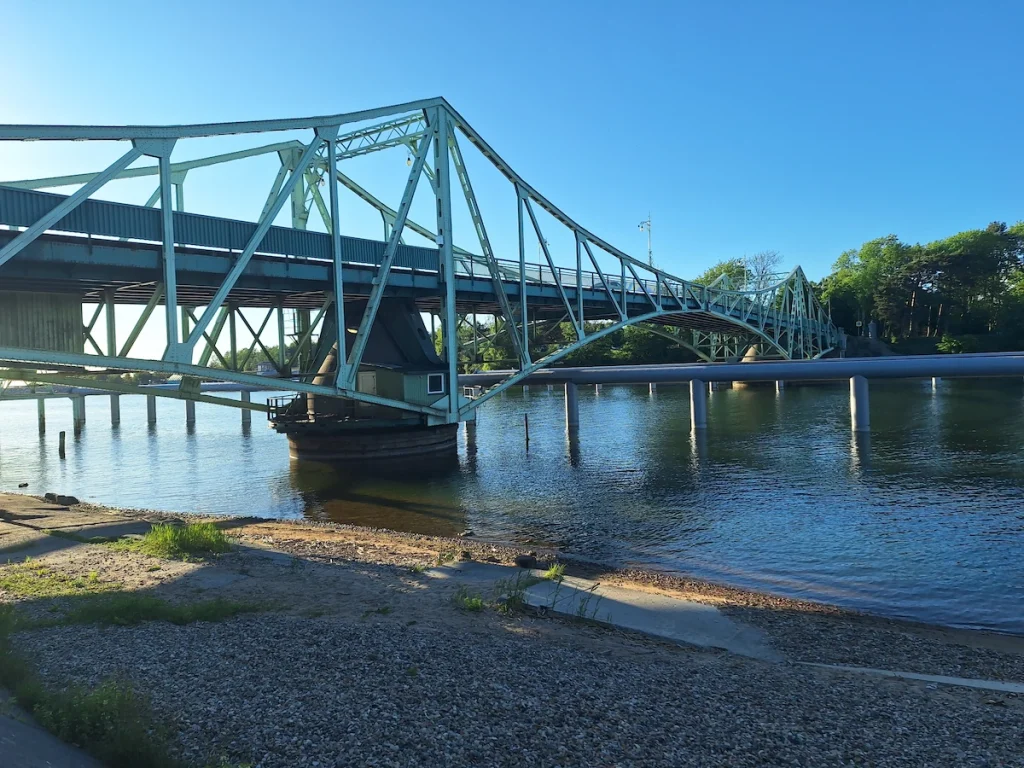
It was damaged by a tanker collision in 2006; rebuilt and reopened in August 2009.
Other landmarks worth noting
- The Manège, Zemgales iela: the roofless shell of a cavalry exercise hall built 1903–1904. The roof — riveted metal and glass tile — was destroyed in WWII. The brick walls remain. Freely accessible from outside; entry to the interior is not recommended.
- Water Tower, General Baloža iela: 37 metres, built c.1903–1905, supplied fresh water to the entire Karosta area. Closed; exterior viewable.
- The Redan, Tosmare nature reserve: a late-19th century fortification element that survived largely intact. A guided interpreter is on site from June to August, 11:00–17:00. Freely accessible year-round.
- Freedom Trail: a 9km waymarked walking route through Karosta, created to commemorate the November 1919 Battle of Liepāja. Starts at the Redan, follows the coast and the Cietokšņa Canal. Five information boards in English. The most structured self-guided option available — no map reading required.
Karosta attractions at a glance
| Attraction | Entry | Season | Time needed |
|---|---|---|---|
| Karosta Prison — standard tour | Paid | Full programme May–Sep | 45–60 min |
| Karosta Prison — overnight stay | Paid | May–Sep | 1 night |
| St Nicholas Naval Cathedral | Free | Year-round | 20–30 min |
| Northern Forts | Free | Year-round | 45–90 min |
| Kalpaka Swing Bridge | Free | Year-round | 15 min, longer if you wait to watch it open |
| The Manège | Free | Year-round | 15 min |
| The Redan | Free | Year-round (guided tours extra, Jul–Aug) | 20–40 min |
| Freedom Trail, full route | Free | Year-round | 3–4 hours |
Walking Karosta: what you’ll actually see
Walking through Karosta is unlike walking anywhere else in Latvia. The architecture alone spans 130 years and three political regimes — and it’s all on the same streets, in the same neighbourhood, lived in by the same community.
The southern section, closest to the canal, has the strongest concentration of Tsarist-era buildings. The officers’ mansions and administrative buildings along and south of the cathedral are brick, detailed, and in various stages of restoration or gentle decay. Some are inhabited. Some are for sale. The brick buildings along Zemgales iela — including the Manège — give the clearest sense of the original Tsarist urban plan.
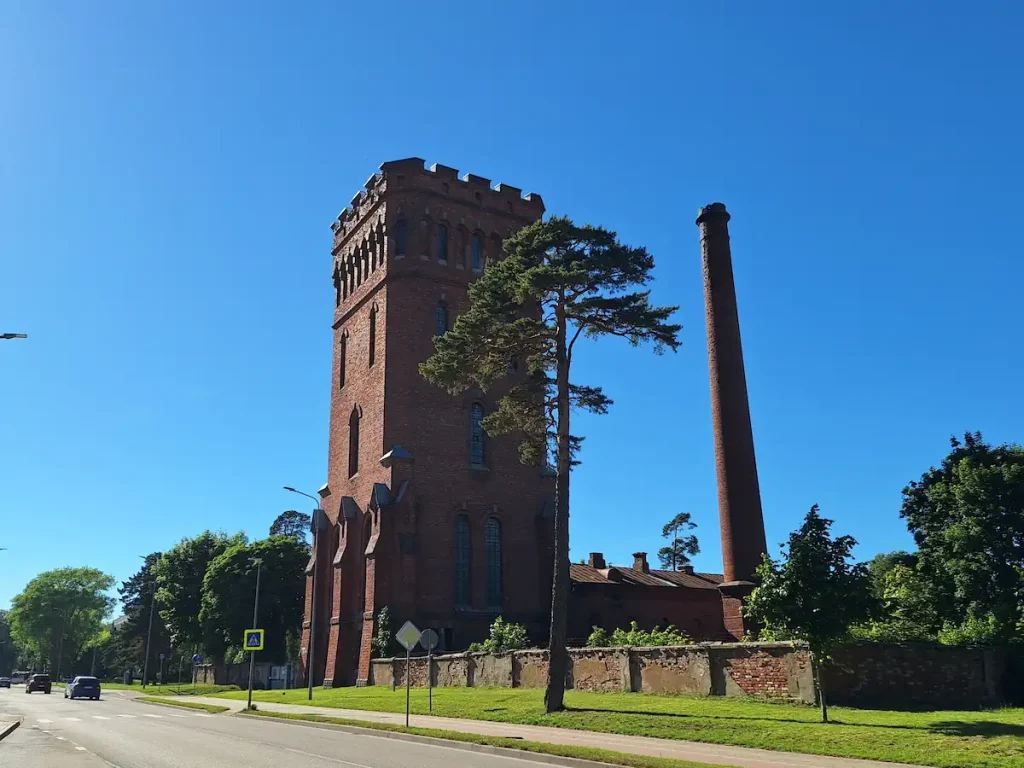
Further north the Soviet-era apartment blocks take over. Some are fully occupied. A handful of the more deteriorated blocks have been or are being demolished. The landscape here is spacious — wide roads, open ground, the Baltic wind coming through — and quiet in a way central Liepāja isn’t.
The submarine bunker sits inside the military harbour basin and is visible from the fence line at the north-western end. You can’t go inside. It’s worth knowing that before you build an expectation around it.
One thing worth being clear about: Karosta is a real neighbourhood. The people you see are residents, not extras. The streets are ordinary streets. The unusual thing about Karosta is not that it feels abandoned — it’s that the history is so visible in every building around you, and that you can walk through it freely.
Who is Karosta for?
Karosta suits independent travellers with a genuine interest in Cold War history, Soviet architecture, dark tourism, or urban exploration. It works well for photographers, history enthusiasts, and visitors who want something genuinely different from the standard Baltic itinerary. It is not ideal for visitors travelling with young children, or for anyone expecting a polished, signposted heritage experience at every turn.
Best for:
- Cold War history and Soviet closed-city history
- Dark tourism — Karosta Prison is one of the most visited dark tourism sites in the Baltics
- Photography: the cathedral against Soviet apartment blocks, the Northern Forts at dawn, the bridge mid-rotation
- Self-guided exploration — Karosta rewards curiosity and time
- Visitors spending at least one full day in Liepāja
Not ideal if:
- You’re travelling with children under 12 (the prison’s interactive experiences require a waiver and are deliberately confrontational)
- You only have an hour — the distances between sites are walkable but not trivial
- You’re expecting café stops, interpretive signage, and facilities throughout the area. Only the prison site has those.
→ You can learn more about events in the city in this guide to what’s on in Liepāja.
What to know before you go
The main practical considerations at Karosta are the seasonal closure of Karosta Prison’s full visitor programme, the genuine coastal erosion hazard at the Northern Forts, and the confrontational nature of the prison’s interactive experiences. The area itself is freely and safely explorable outside the prison. Weather matters more here than in Liepāja city centre — the northern site is exposed.
The prison is seasonal. The standard guided tour and overnight stay run May to September. Outside those months, access may be limited or unavailable. Don’t plan a winter visit around the prison without checking first.
The Northern Forts cliff edge is a real prohibition, not a polite suggestion. Active coastal erosion means the cliff sections above and around the ruins come down without warning. Approach from beach level. Stay clear of the cliff edge and do not walk under the overhanging concrete sections.
The prison’s interactive experience is deliberately confrontational. Behind the Bars and the Extreme Night involve actors playing Soviet military guards — shouting, ordering, physical confinement in cells. Participants sign a waiver before starting. The standard guided tour is straightforward and does not involve any of this.
The bridge has scheduled openings. If you arrive at the bridge and find it open to 90 degrees, a vessel is passing through. Wait — it takes around 20 minutes. There are five daily openings; check the port schedule if timing the visit precisely.
English is limited outside the prison. The prison has English-speaking guides and materials. The rest of Karosta does not. Latvian or Russian is useful if you want to interact with people in the area.
Getting to Karosta from Liepāja
Karosta is 4km north of Liepāja city centre. Bus routes 1, 3, 4, 7, and 8 run from Liepāja centre to Karosta in approximately 20 minutes. Bus tickets cost €0.90 from any newsagent or Narvesen kiosk before boarding, or €1.50 from the driver. Liepāja is a cycling city — the route to Karosta is flat and direct, and takes around 15 minutes by bike.
By bus: Routes 1, 3, 4, 7, or 8 from Liepāja centre. ~20 minutes. Buy tickets in advance from a newsagent — €0.90. Driver tickets are €1.50.
By bicycle: Follow Oskara Kalpaka iela north from the city centre, cross the Kalpaka bridge, and you’re in Karosta. Around 15 minutes from the centre. Bike hire is available in central Liepāja.
By car: Drive north on Oskara Kalpaka iela across the Kalpaka bridge. The Northern Forts have a dedicated free car park. Parking is free throughout Karosta.
On foot: 40–50 minutes from the city centre. Worth doing in good weather — crossing the bridge on foot gives you a proper sense of the geography and the scale of the canal.
How to spend a day in Karosta
A full day in Karosta works best on a south-to-north route, starting at the Kalpaka bridge and finishing at the Northern Forts. This covers the main attractions in logical geographic sequence without backtracking. Allow five to six hours for a relaxed full day, or three hours for a focused half-day that covers the prison, cathedral, and forts.
- Cross the Kalpaka bridge — arrive early enough to watch it rotate if you can. The day’s opening schedule is posted at the bridge. (15 min)
- St Nicholas Naval Cathedral — walk the exterior first to take in the setting; enter after. Women cover heads; no cameras inside. (30 min)
- Karosta Prison tour — book in advance in July and August. The standard tour is 45 minutes and covers the key history. (1 hour including queuing)
- Manège and water tower — a short walk east along Zemgales iela. Exterior viewing; the scale of the ruined cavalry hall is the point. (20 min)
- Walk north through the residential streets — the architecture shifts from Tsarist brick to Soviet concrete as you go. Take the eastern route to pass the officers’ quarter south of the cathedral. (30–45 min)
- Northern Forts — approach from the beach path north of Karosta. Walk along the base of the concrete structures. Keep clear of the cliff edge. (1 hour)
- Return — via the Freedom Trail south if time allows, or back along Atmodas bulvāris to the bridge.
Frequently asked questions
What does Karosta mean in Latvian?
Karosta comes from kara osta, meaning “war port” in Latvian. The name came into use after Latvian independence in 1918. During the Russian Imperial period the base was officially named Port Imperatora Aleksandra III — Port of Alexander III. The name was suppressed under Soviet rule and returned after 1991.
Is Karosta worth visiting?
Yes — if you have at least half a day in Liepāja. Karosta offers something very few places in Europe can: a Soviet-era closed city, intact enough to understand what it was, open enough to walk through freely. The Northern Forts alone justify the bus fare. Visitors who give it a full day consistently find it the most memorable part of a Liepāja trip.
Is Karosta Prison open year-round?
The full programme of guided tours and overnight stays runs May to September. Outside that window, access may be limited — check karosta.lv before planning a winter visit around the prison. The Northern Forts, the cathedral, and the streets of Karosta are freely accessible year-round.
How much does Karosta Prison cost?
The standard guided tour has been priced between €4.50 and €10 in recent years — check karosta.lv for the current price before visiting. The interactive “Behind the Bars” experience and overnight stay are priced separately. Children under 12 are not admitted to the interactive experiences.
Can I visit Karosta without a guided tour?
Most of Karosta requires no tour and no booking — the cathedral, the Northern Forts, the Kalpaka bridge, the Manège, and the Freedom Trail are all freely and independently accessible. Only Karosta Prison requires a paid guided tour. Guided tours of the wider district are also available through the prison and local operators.
Is Karosta suitable for children?
The general area is suitable for families. The Northern Forts require close supervision near the cliff edges. The Karosta Prison standard guided tour is appropriate for older children; the interactive experiences (Behind the Bars, Extreme Night) require a signed waiver and are not recommended for children under 12. The cathedral, bridge, and Freedom Trail are all family-friendly.