
Sun & Sea (Marina) — the Lithuanian opera-performance that won the Golden Lion at the 2019 Venice Biennale — plays Liepāja’s Great Amber Concert Hall from 8 to 11 April 2027. Four nights. A Baltic city of 67,000 people. One of the most decorated works of contemporary art made anywhere in the last decade.
Quick facts — Sun & Sea in Liepāja
- Dates: 8–11 April 2027, multiple performances per day
- Venue: Great Amber Concert Hall
- Pedigree: Golden Lion, Venice Biennale 2019 (Lithuanian national pavilion)
- Best for: Contemporary art and opera audiences — this is one of the most significant works in Europe right now
- Not ideal if: You want conventional opera — there’s no stage, no orchestra pit, no arias in the traditional sense
- Book ahead: Ticket prices rise from 1 September 2026 — book early via the official programme
The Golden Lion is the Venice Biennale’s highest prize in visual art. It is not handed out lightly, and it is not usually given to something that calls itself an opera. Sun & Sea is both a serious artwork and a genuinely strange piece of theatre. Those two things are not in tension here.
In this article
A Lithuanian work anchoring the opening weeks of a Latvian European Capital of Culture is a detail worth noting. Latvia and Lithuania are close geographically, not always culturally aligned. That the most significant early event in Liepāja’s ECoC year crosses the border is, quietly, a statement about what (un)rest is trying to be.
What Sun & Sea Actually Is — and What Happens When You Watch It
Sun & Sea was created by three Lithuanian artists: director Rugilė Barzdžiukaitė, librettist Vaiva Grainytė, and composer Lina Lapelytė. The work premiered at the Venice Biennale in 2019, where Lithuania used it as its national pavilion entry and walked away with the Golden Lion.
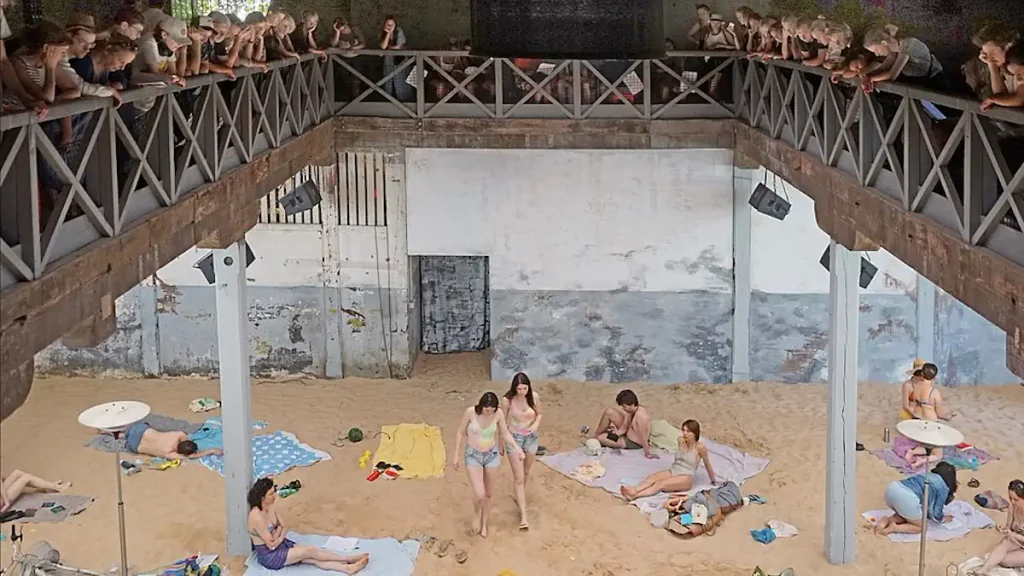
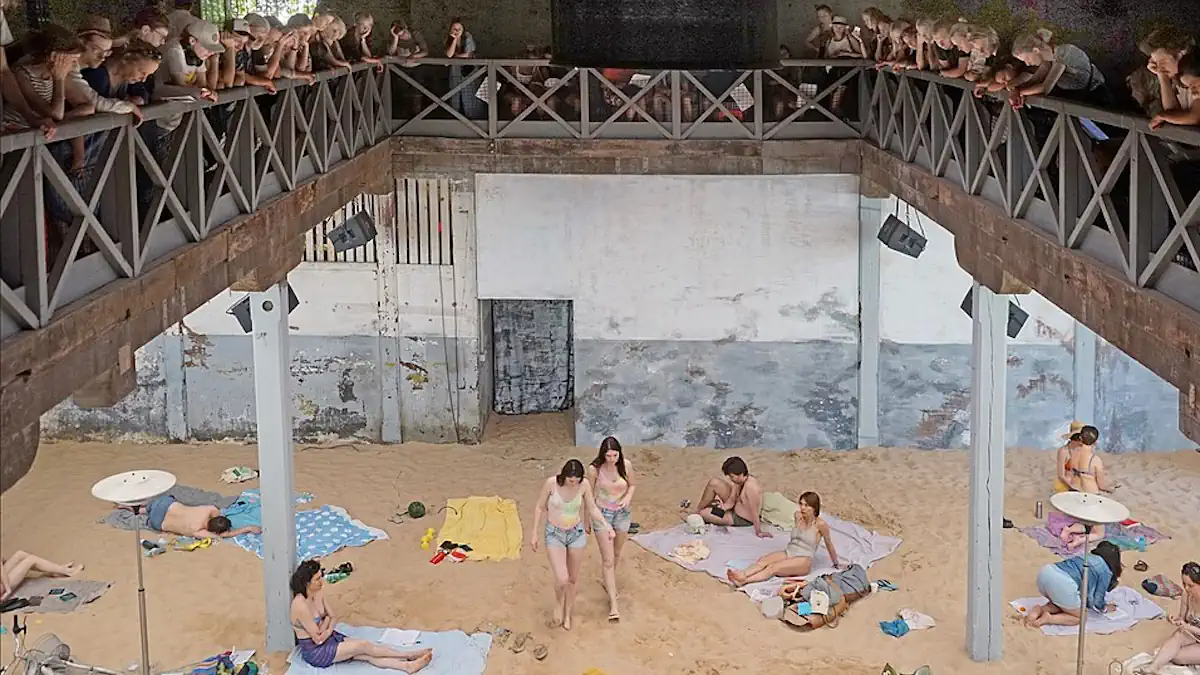
The setup is disarmingly simple. Performers in swimwear lie on an artificial beach. They sing. The audience watches from a balcony above, looking down. There is no stage in the conventional sense, no proscenium, no separation between the performers and an ordinary summer afternoon — except that the ordinary summer afternoon keeps revealing something much darker underneath.
The libretto moves through small observations: sunscreen, children, boredom, the heat. Beneath it, climate anxiety accumulates. The work doesn’t lecture. It lets the mundane and the catastrophic share the same space until the distance between them becomes uncomfortable. This is why it won Venice. It is formally simple and conceptually serious in equal measure.
Why This Work Belongs in the (Un)Rest Programme
The (un)rest programme was built around a single honest acknowledgement: that Liepāja is a city that has never quite settled, and that this unsettledness is something to examine rather than resolve. The thematic strands of the programme engage with contemporary unease — environmental, political, social — without pretending to resolve it.
Sun & Sea is, structurally, exactly that. It stages the gap between how we spend our leisure time and what we know about the world we are spending it in. The beach is not satirised. The people on it are not caricatured. The discomfort is allowed to exist without a resolution, because there isn’t one.
This is not the kind of work that usually opens a regional Capital of Culture. Most ECoC programmes choose safe, large-scale, crowd-friendly anchors for their opening weeks. Liepāja chose a Golden Lion-winning work about climate grief staged as an intimate, site-reconfigured opera. The choice says something about what kind of year this is intended to be.
Great Amber — Where It’s Happening and Why It Can Hold This
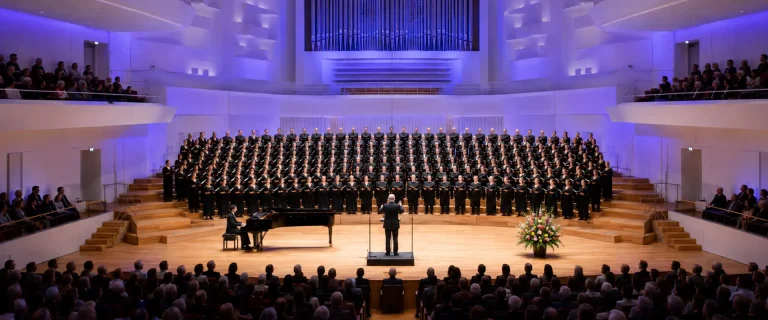
The Great Amber Concert Hall — Lielais Dzintars — sits on the southern edge of Liepāja’s centre, beside the lake. Designed by Austrian architect Volker Giencke and opened in 2015, the main hall seats around 1,000. The building is distinguished by its amber-coloured timber cladding and its acoustic engineering, which was designed specifically for orchestral performance.
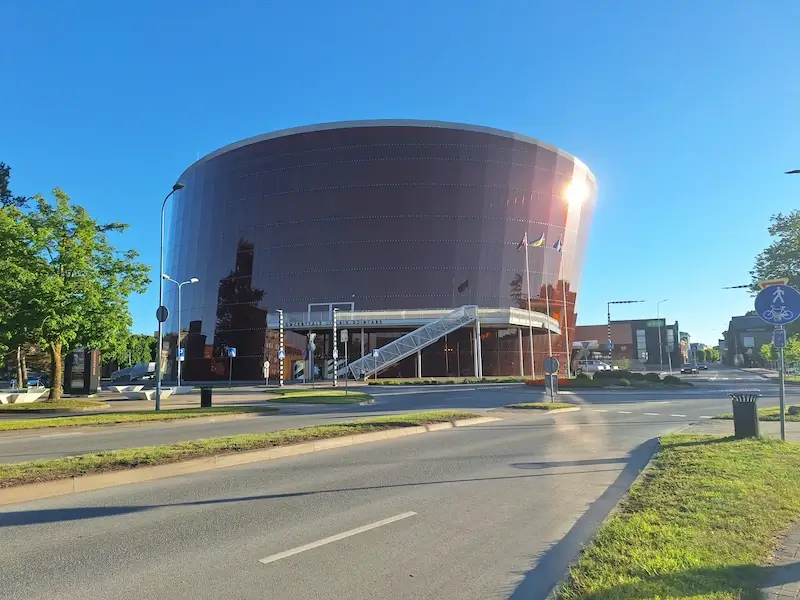
Before it opened, Liepāja had no venue of this standard. The ECoC bid was partly built on the hall’s existence — without it, a city of this size would have struggled to make a credible case for European designation. That the building has now been open for a decade before the ECoC year begins is, in retrospect, good timing.
Sun & Sea works by reconfiguring whatever space it inhabits. The audience-above-performers format requires a venue that can accommodate an elevated viewing position across a large floor area.
Baltic Wind and Baltic Amber: the City Behind the Beach Scene
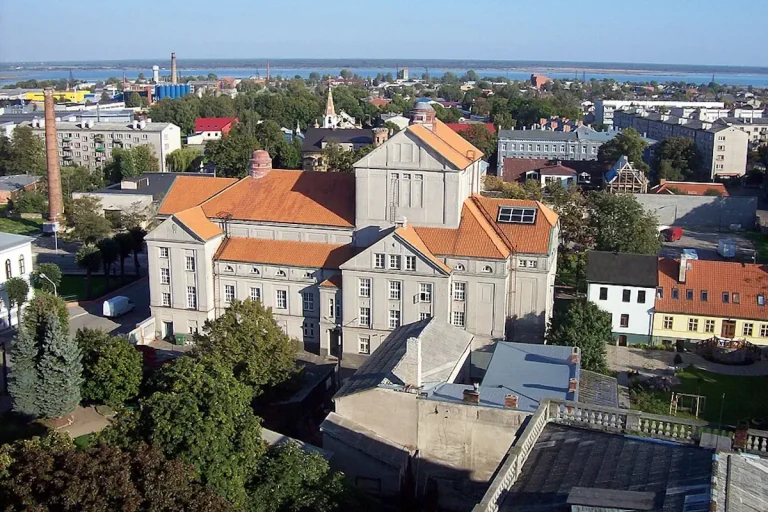
Liepāja was Libau — a Baltic port city with a German-speaking merchant class and a cosmopolitan cultural life, part of the Russian Empire until the First World War dissolved that arrangement. The cultural layers the city carries are not decorative. They are the reason a theme like (un)rest makes specific sense here rather than anywhere else.
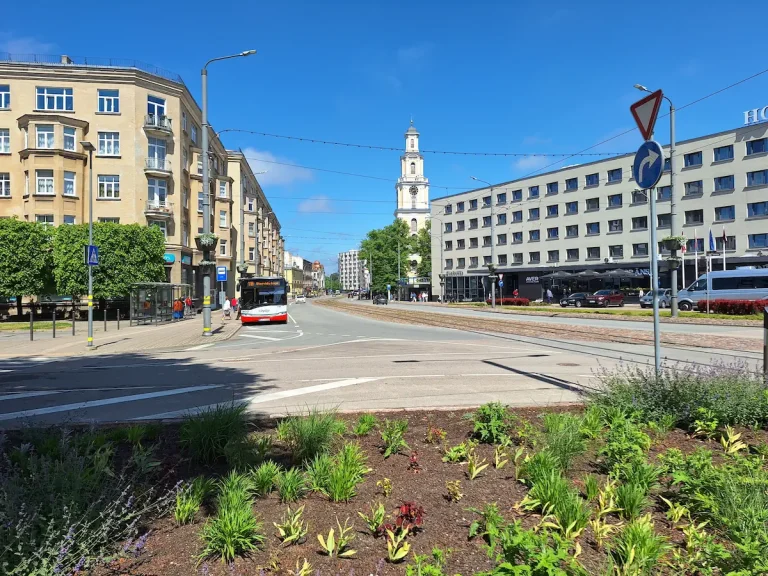
Latvia’s third city now has around 70,000 residents and a coastline on the Baltic Sea. It sits between the sea to the west and Liepāja Lake to the east — geography that gives the city a peculiar sense of being simultaneously open and enclosed. The wind is constant and not merely atmospheric. It is part of daily life.
The Liepāja Symphony Orchestra, founded in 1881, is the oldest in the Baltics. A theatre tradition going back to 1907. And — because Liepāja always surprises — a reputation as Latvia’s rock capital, earned over decades by a city that produces bands at a rate that bears no relationship to its size.
How Sun & Sea Became the Opening Act for a 500-Event Year
The European Capital of Culture designation was created by the European Commission to recognise cities whose cultural identity merits a year-long European spotlight. In 2027, two cities hold the title: Liepāja and Évora in Portugal — not three; České Budějovice in the Czech Republic holds the title the following year, 2028. Liepāja’s programme is called (un)rest. Sun & Sea opens it.
Visiting Liepāja for Sun & Sea
The performances run 8–11 April 2027. April in Liepāja is early spring — cool, often overcast, the tourist season still weeks away. For anyone planning a trip around this, the city will be quiet, which is not necessarily a drawback.
Liepāja is three hours from Riga by road or bus — see getting to Liepāja. Shoulder-season accommodation is easier to find than in summer; browse places to stay for the April dates.
Tickets and further details are available via the official Liepāja 2027 programme page. Background on the work itself — its history, the artists, the Venice Biennale context — is at the Sun & Sea project site.