
The Liepāja 2027 European Capital of Culture programme runs from April to December — nine months of events, exhibitions, performances, residencies, and community projects across a city of 67,000 people and two surrounding regions. If you are thinking about visiting, the practical question is: what is actually happening, and is it worth the trip?
Quick facts — visiting for Liepāja 2027
- Runs: April – December 2027 (opening events from 23 January 2027)
- Territory: Liepāja city, South Kurzeme, Kuldīga Region
- Structure: Five thematic strands — see the (un)rest programme explained
- Best for: Anyone deciding when to visit and what to build a trip around
- Not ideal if: You need the full event list confirmed months out — much of the programme is announced progressively through the year
- Getting there: No scheduled airport service — road, bus, or Stena Line ferry from Travemünde. See getting to Liepāja
The honest answer is that the full programme is still being confirmed as the year goes on. What is already scheduled is enough to make a case. More will be announced progressively through 2027.
In this article
This is what the year looks like from here.
How the Programme Is Structured
The (un)rest programme operates through five thematic strands. They are not separate festivals. They are lenses through which different events are framed. The full breakdown is on the (un)rest programme explainer — in short:
European Dream asks what European identity means when you’re in a city that spent fifty years being told what it was. It looks at solidarity, democracy, and the questions that European culture is currently trying to answer.
Port Paradox is the most Liepāja-specific strand — the contradictions that define the city. Military and musical. Soviet and free. Industrial and artisan. The programme does not resolve these contradictions. It works with them.
New Eyes focuses on rediscovering local communities through unfamiliar perspectives. It involves the full territory — Liepāja city, South Kurzeme, and Kuldīga — and is as much about residents seeing their own place differently as it is about international visitors arriving.
Deliberate Modesty addresses the relationship between the Baltic coast and the natural environment, and the broader question of what sustainable cultural life looks like when you are not a major metropolis.
Creative Foresight is the technology and innovation strand — connecting digital and analogue, younger and older generations, urban and rural communities across the (un)rest land.
Opening: April 2027
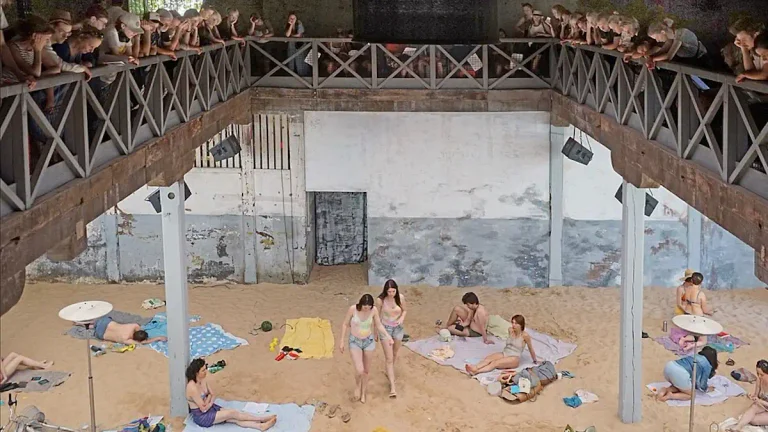
The headline anchor event is Sun & Sea (Saulė ir jūra) — the Lithuanian opera that won the Golden Lion at the 2019 Venice Biennale, making its Latvian debut at the Great Amber Concert Hall from 8 to 11 April. It runs several times per day and is a standing event, staged on an artificial beach with the audience on balconies above.
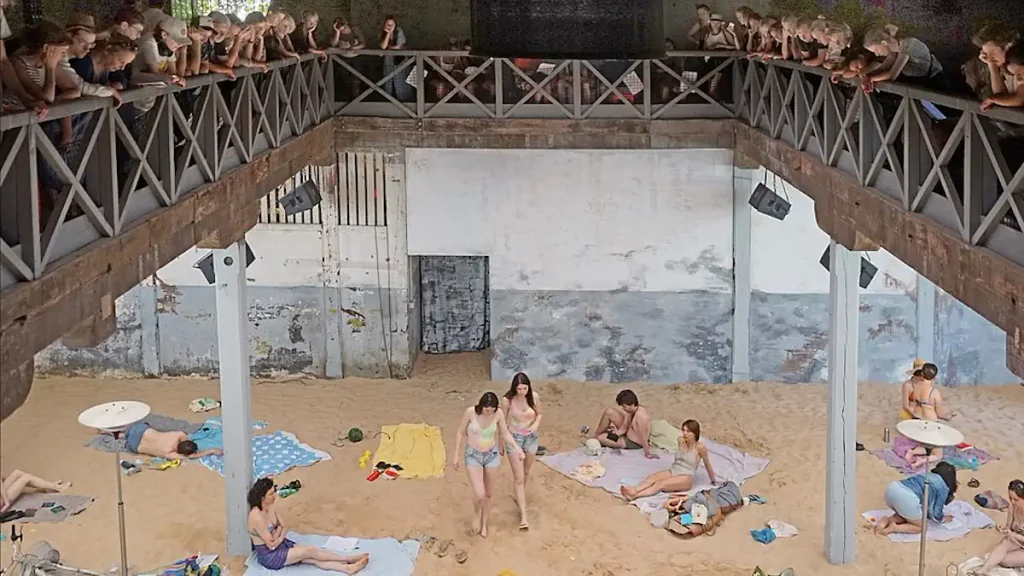
This is a strong opening. It signals the register the programme is working in — international, formally ambitious, locally resonant. Sun & Sea was developed from Baltic Sea memories. It arrives in a city on the Baltic Sea with a derelict naval base on its northern edge. The fit is not accidental.
Tickets are available through Biļešu Paradīze and the official programme site — book ahead, since April dates for a Golden Lion-winning work tend to sell out.
What Else Is Coming
Pre-programme events ran through 2026. In June 2026, the ElektrON – The Future of Amber symposium brought international artists and researchers to Liepāja and Pāvilosta to examine amber as both cultural symbol and contested resource. The resulting exhibition opened at the Liepāja Museum in early 2027, marking the formal start of the ECoC year.
The (un)rest programme includes an open co-financing call for independent organisations across Latvia, meaning the full event list continues to grow as applications are approved. This is worth knowing: some of the best events in any Capital of Culture year are announced six months out, not two years in advance.
What is clear is the programme’s geography. Events happen not just in Liepāja city but across South Kurzeme and the Kuldīga Region — including Kuldīga itself, whose Old Town is a UNESCO World Heritage Site.
The Three Territories
Visitors who come only to Liepāja city will miss part of the picture. The (un)rest land is a concept that covers three distinct territories, each with its own character.
Liepāja city is the hub — the Great Amber Concert Hall, the Theatre, the Museum, the MPLab at RTU Academy. The main programme is centred here.
South Kurzeme Region is the largest municipality in Latvia by area. It includes coastal villages, the artist residency at Pāvilosta, and the town of Grobiņa — the oldest settlement mentioned in Latvian written records. Amber washes up on its beaches.
Kuldīga Region is different again — inland, quieter, medieval. Kuldīga town sits on the Venta River. The Suiti cultural space in Alsunga is on UNESCO’s Intangible Heritage list. Kuldīga’s Old Town is UNESCO World Heritage. These are not footnotes. They are reasons to extend a trip.
Nine Months, Two Ticket Types, No Airport
The programme runs nine months, which means different things to different visitors. A weekend in April for the opening events is a different experience from a week in July or a long autumn weekend in October.
Most exhibition and community events are free. Ticketed events — major performances, opera, large-scale concerts — sell out in advance. The Great Amber Concert Hall has a finite capacity and a reputation that attracts audiences from across the Baltics and beyond.
Liepāja does not have an airport with regular commercial service. It is reached by road or bus from Riga (three hours), by car from Lithuania and Estonia, or by Stena Line ferry from Travemünde in Germany — see getting to Liepāja for the full breakdown. The ferry connection matters — it brings visitors from Germany and Scandinavia who come specifically for the city.
English is spoken at hotels and major venues. Beyond that, Latvian or Russian will serve you better, though younger Latvians often have some English. If you have a local contact, use them.
Two Cities, One Designation: How the ECoC Title Actually Works
The ECoC designation is awarded by the European Commission to cities across the continent — typically two per year, one from each of two rotating country groupings. For 2027, the two are Liepāja (Latvia) and Évora (Portugal); České Budějovice (Czech Republic) holds the title the following year, 2028. The designation runs for one full calendar year and comes with European funding, international visibility, and the expectation that the city will use it to build something lasting. What Liepāja builds with it is the interesting question — see why Liepāja won the designation.
Getting In, Getting Settled
Liepāja is a three-hour drive or bus journey from Riga, or reachable by Stena Line ferry from Travemünde — see getting to Liepāja. For accommodation and a practical guide to the city, this site has the full picture. The official programme is at liepaja2027.lv.